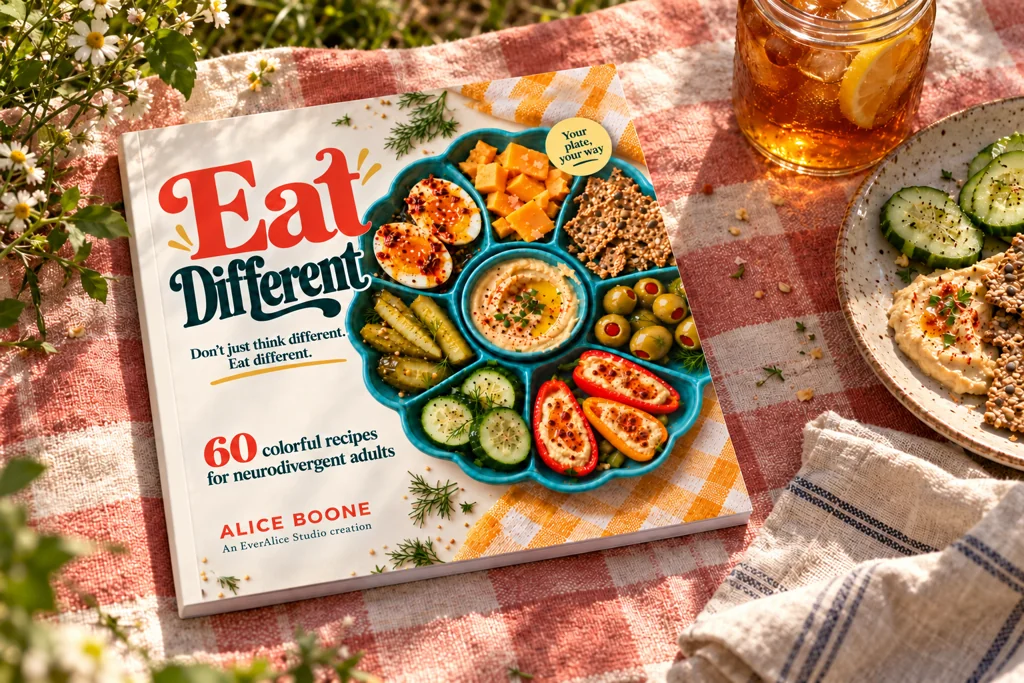
I am a neurodivergent creator and the founder of EverAlice Studio. I created Eat Different around a simple idea: food should work with your brain and your senses.
I wanted a cookbook that feels bright and inviting without making every meal another demanding project. Familiar foods, convenience ingredients and repeating a favorite all deserve a place here. Choose what fits your energy, keep textures separate if you prefer, and make small changes only when you want to.
Cooking asks for more than a recipe.
A recipe begins well before the first instruction. There is deciding what sounds good, checking ingredients, finding the right pan, keeping track of the next step and thinking about cleanup. An easy-sounding dinner can still feel like a lot.
For a cookbook that considers executive function, I wanted the route into the recipe to matter as much as the finished plate. Eat Different includes a finder organized around how much cooking you want to do, active and total times, tools, and an easier option alongside the recipe.
Some days that means assembling The Favorites Plate. On another day, a warm bowl of Miso Corn and Tofu Ramen might sound worth the time. Both are meals you can choose without turning dinner into a test.
Autism, ADHD and room for sensory preferences.
This book is for neurodivergent adults, including autistic and ADHD readers. That does not mean everyone wants the same textures, flavors or amount of choice. A sensory-friendly cookbook needs to leave decisions with the person eating.
The recipes describe textures and offer sensory swaps, so you can look for the kind of food you want: cool and crunchy, warm and soft, separate components, or a sauce you can add yourself. Optional spice stays optional. An easier preparation is still a valid way to make the meal.
The Buldak Egg Crunch Plate is one example. It has an optional hot sauce and a mild soy-maple alternative. Miso Corn and Tofu Ramen offers the option to keep the egg and corn in side dishes. These are small choices, but they make the recipe easier to make your own.
Familiar foods and variety can sit together.
A repeated favorite belongs in a cookbook, too. Familiar food can bring predictability; trying something different can be enjoyable when you want it. You do not have to trade one for the other.
A trusted base with one optional change is the idea: a dip on the side, a different spice, or a vegetable prepared another way. You can also leave the meal exactly as it is. The point is having room to choose.
You do not need a perfect routine or a perfect plate. My hope is that this book helps you find food that feels doable, satisfying and yours.
What you’ll find in Eat Different.
There are 60 recipes: 46 savory options and 14 desserts. The book moves from simple plates and quick meals to recipes for days when you feel like cooking, with comfort meals and Asian-inspired options along the way.
- A place to start: recipe finders, active and total times, and tools listed up front.
- Flexible ways through: an easier option and a sensory swap beside the recipe.
- Useful navigation: an A–Z index and dedicated gluten-free and no-cook/quick-heat finders in the square paperback.
- Practical notes: cooking, storage and ingredient-label reminders.
The recipes use no peanut ingredients, with tree nuts and other allergens present. Twenty are marked GF when made with labeled gluten-free ingredients. Those labels are starting points for checking ingredients, not a guarantee about packaged products or cross-contact.
See the cookbook and actual page previews →
From creative idea to cookbook, with EverAlice Studio.
Created by Alice Boone and EverAlice Studio. Concept and creative direction by Alice Boone. EverAlice exists to help creative ideas become usable, editable files.
As its founder, I care about the stretch between having an idea and finishing something people can use. Eat Different connects that work to my own interests: clear content, inviting visuals and choices that do not require a perfect routine.
The project was made with EverAlice Studio, with AI-assisted creative work, additional editing tools and hands-on layout and print preparation. It is a finished creative project shaped through decisions and revisions along the way.
If you know me through my design work or through EverAlice, this is another expression of the same interest: helping ideas become useful, tangible things. You can explore the studio at EverAlice Studio ↗.
Choose the copy that fits how you read.
The new square paperback is $24.99 USD, with 72 pages in an 8.5 × 8.5-inch format. The landscape hardcover is $39.99 USD, and the digital PDF is $9.99 USD. Both landscape editions have 68 pages.
All three contain the same 60 recipes, with different layouts and cover designs. Each is sold separately through Lulu; print shipping and applicable taxes are shown at checkout.
Start with a look at the pages. Find a meal that feels doable. Keep the parts you like.
Explore the three editions →